Most homeowners do not choose the solar mounting — their installer does. But the mounting is the only part of a solar installation that goes through your roof. It is worth understanding what the different approaches involve, and what separates them over a 20-year lifespan.
This article covers the two main approaches used on UK roofs: traditional roof hooks with plastic flashing, and the SolVe Mount.
Conclusion
Because no tile is removed, the installation risks associated with traditional hooks — tile breakage, grinding, fatigue cracking, flashing aperture stress concentrations — do not arise. There is nothing to hook, nothing to flash, and nothing to inspect annually.
Key Takeaways
Traditional roof hooks require at least one tile to be removed per fixing point — the SolVe Mount removes none
Plastic flashing carries a typical 10-year warranty and is fully exposed to UV; the SolVe Mount carries a 20-year guarantee with a VMQ silicone seal rated to last well beyond that
The SolVe Mount is 33% stronger than standard, carries an 8.2× storm margin, and achieves IPX8 watertight certification
Hook installations require grinding tiles with an angle grinder; cyclical contact between hook and covering under wind and snow load can cause fatigue cracking over time
The SolVe Mount's airtight VMQ seal leaves no air void — the fire rating of the roof covering is fully preserved
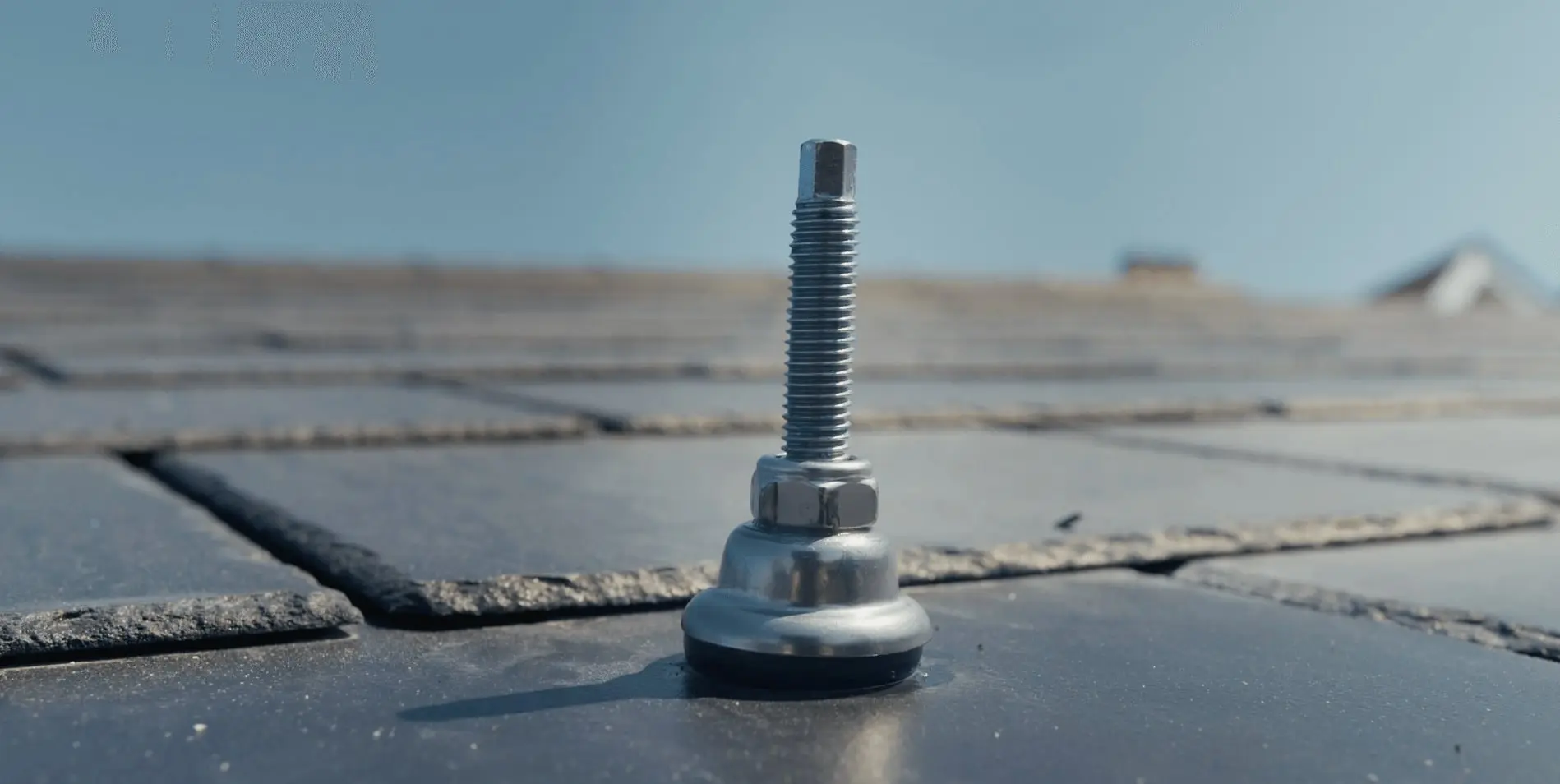
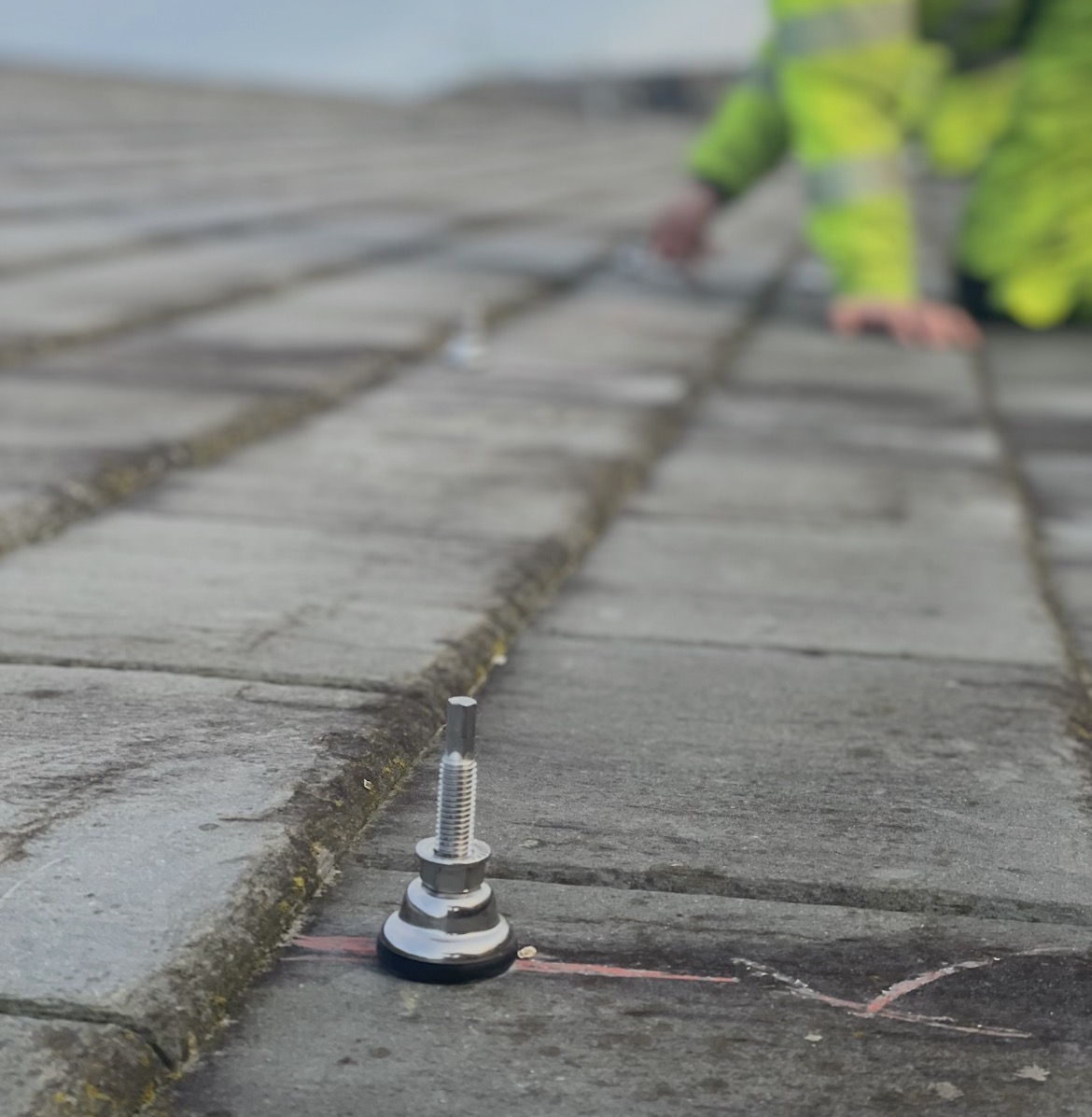
The SolVe Mount installed on a UK roof. No tiles removed. IPX8-rated VMQ silicone seal.
In This Article
1. How Traditional Roof Hooks Work
A traditional roof hook installation works as follows. One or more tiles are removed from the roof to expose the rafter beneath. The hook is positioned on the rafter and fixed with two wood screws. The tiles are then put back — installers or roofers should grind away sections of the tiles so they sit back down properly around the metal hook.
No grinding is done
When the tiles are not ground to fit around the hook, they cannot sit correctly in their channel. The hook is left in direct contact with the underside of the covering — a load the tile was not designed to bear.
The hook contacts the roof covering regardless
Even when grinding is done, the hook will still contact the roof covering in high winds and under snow load. As the rail system bends and flexes, the hook moves relative to the tile — creating cyclical contact that can cause fatigue over time.
Occasionally plastic flashing is used over the hook, or a rectangle is cut out of the slate or tile to slide the flashing into. This does not prevent the hook from flexing in high winds or when installers are walking on the rails.
During high winds and under snow loading, the rail and hook system moves relative to the roof. Years of cyclical contact between the hook and the tile or slate can cause fatigue, eventually cracking the covering at the point of contact.
Tiles must be ground to seat the hook
The tile beneath the hook must be notched or ground using an angle grinder to create clearance for the hook body. If this is not done accurately, the tile will not sit correctly in its interlocking channel and the hook will be in direct contact with the covering.
Tile removal carries a breakage risk
Removing a tile to install the hook risks breaking it — particularly on older slate. A cracked slate must be replaced before reinstallation, adding cost and time on every hook across the array.
When a rectangular aperture is cut into a slate for the flashing, the four corners become stress-concentration points where cracking is more likely under load or thermal cycling — compounding the fatigue risk above.
Hooks can be bent during installation
As installers walk on the rails, hooks can be pushed down into the roof covering, placing unintended load on the tile or slate at the contact point.
Material limitations of plastic flashing
ABS (Acrylonitrile Butadiene Styrene) is a thermoplastic. Carbon black is added to slow UV degradation, but it does not prevent it. Three specific limitations apply to plastic flashing on a UK roof — all documented in our VMQ vs Flashing article:
Upper service temperature
Outdoor ABS is rated to +60–80 °C continuous. On a dark tile in direct UK summer sun, the tile surface regularly reaches +70 °C — plastic flashing operates at or near its upper service limit on hot days.
Frost brittleness
ABS impact strength drops significantly below 0 °C. UK winters routinely go below 0 °C. A rigid thermoplastic flashing held by a hook under mechanical tension becomes a stress-cracking risk in frost.
UV photodegradation
Carbon black delays but does not prevent the gradual oxidative breakdown of the butadiene component. The flashing sits fully exposed to UV with no covering above it, and carries a typical product warranty of 10 years.
3. How the SolVe Mount Is Different
The SolVe Mount uses a fundamentally different method. A 28mm core drill creates a clean, circular hole through the roof covering. The tile stays in place — no tile is removed, no hook touching the roof covering, and no flashing is fitted over surrounding tiles.
An A4-80 stainless steel bolt passes through the hole and fixes directly to the rafter below. A VMQ silicone seal sits on the bolt and is compressed axially when the bolt is tightened — expanding radially to fill the core hole completely, sealing within the roof covering like a rivet. The result is a watertight seal that forms part of the covering itself, rather than sitting on top of it.
The SolVe Method — Three Steps
1. Core drill
28mm hole through the roof covering. No tile removed. Covering stays structurally intact.
2. Fix to rafter
A4-80 stainless steel bolt passes through the hole and fixes directly to the rafter below.
3. Seal
VMQ silicone seal expands radially when tightened — seals within the hole like a rivet. IPX8 rated.
The airtight VMQ seal leaves no air void in the roof covering. UK Building Regulations Approved Document B and MCS 012 3.0 both require that the fire performance of the roof is not compromised by the mounting installation. The SolVe Mount meets both. Full fire safety article.
Conclusion
Because no tile is removed, the installation risks associated with traditional hooks — tile breakage, grinding, fatigue cracking, flashing aperture stress concentrations — do not arise. There is nothing to hook, nothing to flash, and nothing to inspect annually.
4. Side-by-Side Comparison
Factor
Traditional hook + flashing
SolVe Mount
Tiles removed
Yes — at least one tile removed per fixing point
None — 0 tiles removed
Seal type
ABS plastic flashing overlapping surrounding tiles; sometimes loose neoprene stuffed at the gap
IPX8-rated VMQ silicone seal, expands radially within the core hole
Seal warranty
Typically 10 years
20 years
Storm margin
Not independently specified
8.2× standard storm load
Structural strength
Standard
33% stronger
Profile
Raised hook above roof covering
Low profile
Fire rating
Aperture in roof covering; fire performance depends on installation practice
Airtight VMQ seal, no air void — fire rating fully preserved. MCS 012 3.0 and Approved Document B compliant
Ongoing maintenance
Annual inspection of hook and flashing recommended
In one of the largest single SolVe installations on record, 930 mounts were fitted at Petersfield Hospital — a working NHS site, with full MCS certification, and zero tiles removed across the entire array.
Petersfield Hospital — 930 SolVe Mounts. Zero tiles removed. Full MCS certification.
A single-page PDF summarising the SolVe Mount's credentials — designed to share with homeowners who want to understand what is going through their roof.
What is the difference between a roof hook and the SolVe Mount?
A traditional roof hook requires removing one or more tiles to expose the rafter, fixing the hook to the rafter with two wood screws, and grinding sections of the tiles so they sit back down around the metal hook. Plastic flashing is sometimes fitted over the hook, but this does not prevent the hook from flexing in high winds or under snow load. The SolVe Mount uses a 28mm core drill to create a clean hole through the roof covering — no tile is removed. A VMQ silicone seal expands within that hole when the bolt is tightened, sealing it like a rivet. There are no hooks, no flashing, and no loose components.
Does the SolVe Mount remove tiles?
No. The SolVe Mount requires a 28mm core drill through the roof covering. Zero tiles are removed. This is one of the key differences from traditional roof hook systems, which require at least one tile to be removed and lifted per fixing point.
How long does the SolVe Mount seal last?
The SolVe Mount carries a 20-year guarantee. The VMQ silicone seal material has a projected service life well beyond that, based on accelerated thermal ageing studies and the inherent stability of the Si–O polymer backbone. For comparison, ABS plastic flashing carries a typical product warranty of 10 years.
Is the SolVe Mount approved for MCS installations?
Yes. The SolVe Mount is certified to MCS 012 3.0 — the UK standard for solar mounting systems. It is also compliant with UK Building Regulations Approved Document B (fire safety) and meets BS EN 13501-5 BRoof(t4) classification.
Which roof types does the SolVe Mount work on?
The SolVe Mount is compatible with a wide range of UK roof coverings including slate, composite slate, heavy slate, Cambrian interlocking slate, concrete plain and interlocking tiles, clay plain tiles, Rosemary tiles, and Cotswold stone. Dedicated guidance for each covering is available in our roof type guides.